
☰
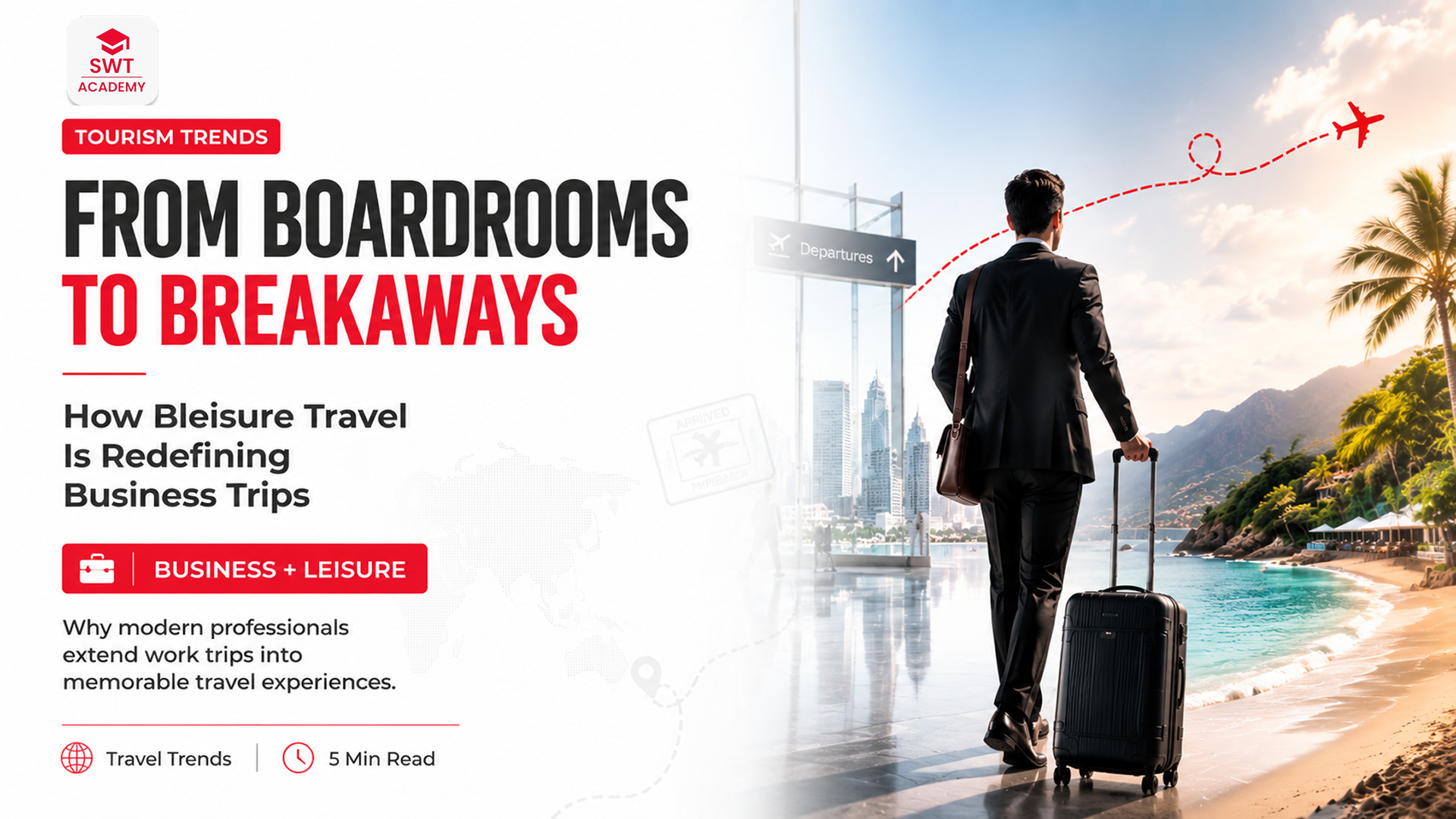
Have you ever travelled to another city for a meeting and thought, "Why not stay a little longer and explore?"
Imagine attending a business conference in Mumbai, completing your meetings in Delhi, or visiting a client in Goa—and then extending your trip to discover the destination.
This changing travel behaviour has a name—Bleisure Travel.
Bleisure combines "business" and "leisure", allowing travellers to extend work-related trips for personal travel, relaxation, and exploration.
What was once simply a business journey is now becoming an opportunity to experience a destination.
Today's business travellers are increasingly looking for flexibility, convenience, and meaningful experiences beyond the conference room.
This trend is creating exciting opportunities across Tourism & Hospitality, corporate travel, hotels, airlines, MICE tourism, and destination management.
The tourism industry is constantly evolving, and Bleisure Travel is becoming an important trend influencing how people plan and experience business trips.
Business travel is no longer limited to travelling for meetings and returning home immediately.
Traditional business travel often followed a simple pattern—arrive, attend meetings, and return home.
Bleisure is changing this behaviour.
Travellers may arrive a day earlier or stay a few extra days after completing their professional commitments.
They may use this additional time to:
A three-day business trip can therefore become a five- or six-day travel experience.
This creates additional opportunities for hotels, restaurants, tour operators, transportation providers, and local businesses.
Hotels have traditionally focused on the practical needs of business travellers—comfortable rooms, Wi-Fi, meeting facilities, and convenient locations.
But Bleisure is changing what guests expect.
Business travellers extending their stay may also look for:
Hotels therefore have an opportunity to move beyond accommodation and become part of the traveller's overall destination experience.
A conference or business meeting can introduce thousands of travellers to a destination.
Instead of spending their entire trip between the airport, hotel, and meeting venue, Bleisure travellers may explore the city during their free time.
They may visit:
This gives tourism boards and destination management organisations an opportunity to promote cities not only as business destinations, but also as leisure destinations.
A conference can bring the traveller to a city.
The destination experience can give them a reason to stay.
Meetings, Incentives, Conferences and Exhibitions (MICE Tourism) are an important part of the tourism industry.
But the opportunity does not end when the event finishes.
A corporate conference can become the starting point for a leisure experience.
Participants may extend their stay to:
This creates opportunities for travel companies and event organisers to develop business + leisure packages around conferences and corporate events.
Possible offerings include:
Bleisure travellers often have fixed professional schedules.
Their leisure plans need to fit around work commitments.
Travel companies can therefore offer:
Today's travel professional does much more than book flights and hotels—they help travellers connect business commitments with personal travel goals.
India's growing business travel ecosystem, expanding connectivity, MICE infrastructure, and diverse tourism destinations make it ideal for Bleisure Travel.
Examples include:
Travel businesses can create business + leisure itineraries around these destinations.
Career opportunities include:
Professionals require:
A business traveller is no longer simply a professional moving from one meeting to another.
They are also:
The future of business travel is increasingly connected with:
A business trip is no longer only about completing professional commitments—it is also an opportunity to discover something new.
The rise of Bleisure Travel demonstrates how business and leisure are becoming increasingly connected.
Examples include:
This creates opportunities for:
The question is no longer:
"How can we serve the business traveller?"
It is becoming:
"How can we help the business traveller experience the destination?"
Students can explore careers in:
Employers seek professionals with:
Modern Tourism & Hospitality professionals need to understand:
The Tourism & Hospitality programs offered under Tata Institute of Social Sciences School of Skill Education (SSE), facilitated by SWT Academy, help students develop:
This prepares students for careers across:
A conference can become a city break.
A meeting can become a weekend getaway.
A corporate event can become a destination experience.
A business trip can become an opportunity to discover somewhere new.
Bleisure Travel creates opportunities for:
The future of business travel will not be defined only by meetings, conferences, and corporate schedules.
It will also be shaped by what travellers choose to do before the meeting begins and after the meeting ends.
As Bleisure Travel continues to influence traveller behaviour, it is creating a new way of looking at business journeys—where professional commitments and personal experiences can exist within the same trip.
For destinations, it creates new ways to attract visitors.
For hotels, it creates opportunities to extend stays and deliver personalised experiences.
For travel companies, it creates opportunities to design smarter and more flexible itineraries.
For local businesses, it can generate additional visitor spending.
And for Tourism & Hospitality professionals, it opens the door to a growing world of careers where business travel meets leisure, hospitality, and experience.
Through the Tourism & Hospitality programs offered under Tata Institute of Social Sciences School of Skill Education (SSE), facilitated by SWT Academy, students can develop the practical skills, industry exposure, and professional confidence needed to succeed in a rapidly evolving industry.
Because the future of business travel is not just about where work takes you. It is also about where the journey takes you next.