
☰
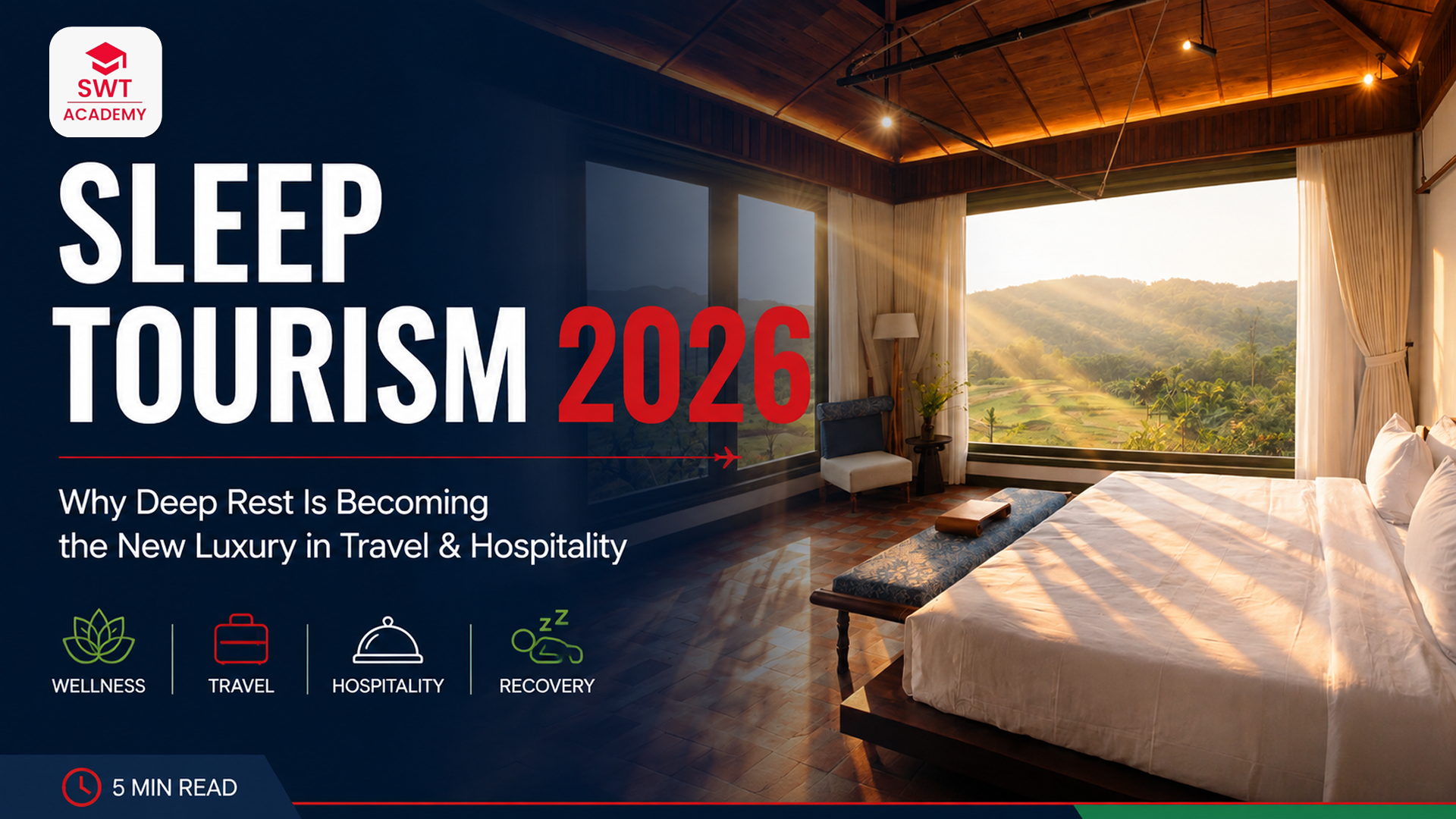
What if the next big travel experience is not about seeing more places?
What if it is about doing less, slowing down, switching off, and finally getting a good night's sleep?
For decades, travel has often been associated with packed itineraries, sightseeing, adventure activities, nightlife, shopping, and exploring as much as possible.
But traveller expectations are changing.
In 2026, a growing number of travellers are looking for something much simpler:
Rest. Recovery. Silence. Nature. Wellbeing.
This shift is giving rise to an emerging tourism trend known as Sleep Tourism.
Sleep tourism focuses on travel experiences designed around better rest and recovery. Hotels, resorts, wellness retreats, and hospitality businesses are increasingly experimenting with sleep-focused rooms, quiet environments, personalised sleep programmes, wellness activities, better bedding, digital detox experiences, and nature-based stays.
The Global Wellness Institute has identified Sleep Tourism and the growing sleep divide as a major sleep trend for 2026, highlighting how hospitality businesses are creating environments specifically designed to support restorative rest.
This creates an important question for the future of tourism:
Could sleep become one of the most valuable hospitality experiences of the future?
The answer appears to be increasingly yes.
Sleep tourism is a form of wellness tourism where improving rest and recovery becomes an important part of the travel experience.
Instead of travelling only to explore a destination, guests may choose a hotel or resort because it provides an environment designed to help them relax and sleep better.
Sleep-focused hospitality can include:
The concept goes beyond simply providing a comfortable bed.
It is about designing the entire guest journey around rest and recovery.
Travel publications are already reporting a growing number of hotels and wellness properties offering sleep-focused programmes, from specialised treatments and sleep experts to smart beds and sleep-enhancing room environments.
In other words:
The room is no longer simply where the guest sleeps.
It can become part of the wellness experience itself.
Modern lifestyles are increasingly fast-paced.
People spend long hours working, commuting, studying, using smartphones, attending meetings, managing responsibilities, and constantly responding to digital notifications.
Even holidays can become stressful.
A traveller may spend an entire vacation moving from one attraction to another, taking photographs, checking social media, answering emails, and following a tightly packed itinerary.
The result?
The traveller returns home needing another holiday.
This is changing the way people think about travel.
Many travellers now want holidays that help them:
This is one reason wellness travel and restorative tourism are becoming increasingly important.
The Global Wellness Institute's 2026 wellness tourism trends also highlight growing demand for experiences centred on deep rest, nervous-system recovery, nature, privacy, and personalised wellness.
Travel is therefore shifting from:
“How much can I experience?”
to:
“How much better can I feel when I return?”
Traditionally, hotels competed through:
Now, another factor is becoming increasingly important:
Sleep quality.
Hotels are beginning to recognise that guests remember how they felt during their stay.
A guest who sleeps well, wakes up refreshed, and feels relaxed may associate that positive experience strongly with the hotel.
This creates opportunities for hospitality businesses to rethink the traditional hotel room.
A sleep-focused hotel room could feature:
These may appear like small details.
But in hospitality, small details can create powerful guest experiences.
Hotel design is also becoming an important part of wellness hospitality.
A room designed for better sleep may consider much more than furniture.
It may consider:
Bright artificial light late at night can interfere with a relaxing bedtime environment. Hotels can therefore use warmer, softer lighting during evening hours.
Traffic, elevators, corridors, entertainment areas, and neighbouring rooms can affect guest comfort.
Soundproofing and thoughtful room placement can become valuable hospitality features.
Comfortable room temperatures can influence the overall sleeping environment.
Mattresses, pillows, sheets, blankets, and overall bed quality remain central to the hotel sleep experience.
Smart room systems can allow guests to control lighting, temperature, curtains, and other features conveniently.
This creates an important opportunity for hospitality professionals.
The future hotel employee may need to understand not only guest service, but also guest wellbeing and experience design.
Sleep tourism does not exist separately from wellness tourism.
It is becoming part of a much larger wellness travel ecosystem.
Modern wellness travellers may combine sleep-focused experiences with:
The goal is not necessarily to create an intense programme.
Instead, it may be about creating a balanced environment where travellers can naturally slow down.
The Global Wellness Institute's 2026 wellness tourism research highlights this movement toward deep rest, personalised wellness, nature-based recovery, and shorter restorative breaks.
This is particularly relevant for hospitality businesses because wellness no longer means only having a spa.
Wellness can become part of the entire guest experience.
Technology has made travel easier.
We can book hotels instantly.
We can navigate unfamiliar cities.
We can translate languages.
We can communicate with family.
We can work from almost anywhere.
But constant connectivity can also make it difficult to switch off.
This has created another opportunity within sleep tourism:
Digital detox travel.
Some travellers may actively seek destinations where they can reduce screen time.
Hotels can respond by creating experiences such as:
The purpose is not to reject technology.
It is to help guests use technology intentionally rather than continuously.
For hospitality professionals, this creates a new way of thinking about guest experience.
Sometimes the best service may be giving guests space to disconnect.
Nature has always been an important part of tourism.
But in sleep tourism, nature can become part of the actual wellness experience.
Travellers may choose:
The attraction is not only the destination itself.
It is also the atmosphere.
Fresh air, natural surroundings, quieter environments, slower routines, and reduced urban stimulation can contribute to a more relaxing travel experience.
This connects sleep tourism with other emerging trends such as nature tourism, sustainable tourism, slow travel, wellness tourism, and experiential travel.
The destination therefore becomes more than a sightseeing location.
It becomes a space for recovery.
Not everyone has time for a seven-day wellness retreat.
Modern travellers may prefer shorter experiences.
This is creating opportunities for:
The Global Wellness Institute's 2026 wellness tourism trends highlight the growth of shorter, restorative travel experiences, including urban recovery breaks and nearby wellness escapes.
This is especially interesting for hotels.
A property does not necessarily need to be located in a famous international destination to benefit.
A hotel near a major city could create a weekend sleep and recovery package.
For example:
Friday evening: Check-in and digital detox
Saturday morning: Nature walk and healthy breakfast
Saturday afternoon: Spa or relaxation experience
Saturday evening: Quiet dinner and sleep-focused environment
Sunday morning: Slow breakfast and wellness activity
The guest does not need to travel thousands of kilometres.
The experience itself becomes the product.
Artificial Intelligence is already transforming tourism.
But its role may go beyond itinerary planning and customer service.
AI could increasingly support personalised wellness travel.
For example, a hotel could use guest preferences to personalise:
Imagine a traveller arriving at a hotel after a long journey.
Instead of receiving a generic experience, the hotel understands that the guest prefers:
A quiet room + low lighting + late breakfast + wellness treatment + minimal notifications.
This is the direction in which personalised hospitality is moving.
The Global Wellness Institute identifies AI-designed wellness travel as one of its 2026 wellness tourism trends, with technology increasingly helping travellers create experiences around individual needs and preferences.
The future could therefore combine:
AI + Wellness + Hospitality + Personalisation.
Every new tourism trend creates new business models.
And every new business model creates new career opportunities.
Sleep tourism could create opportunities across:
Hospitality professionals may increasingly need to understand how to design experiences rather than simply perform operational tasks.
For example, a hotel professional could be involved in creating:
This means the future hospitality professional needs a broader skill set.
The growth of wellness and sleep tourism does not mean traditional hospitality skills are becoming less important.
In fact, they are becoming more valuable.
Future hospitality professionals should develop:
Most importantly, professionals need to understand one fundamental idea:
Hospitality is about understanding people.
Technology can identify preferences.
But humans create emotional connections.
At first glance, sleep tourism may appear unrelated to sustainability.
But there is an interesting connection.
Many sleep-focused experiences naturally fit with slow travel and local tourism.
Instead of travelling long distances for a packed itinerary, travellers may choose:
This can help diversify tourism beyond overcrowded destinations.
It can also create opportunities for smaller hotels, homestays, local communities, and rural tourism businesses.
Sustainable tourism is therefore not only about reducing environmental impact.
It is also about creating long-term value for destinations and local communities.
Luxury hospitality has traditionally been associated with:
But luxury is changing.
For many modern travellers, luxury may simply mean:
Quiet.
Privacy.
Comfort.
Time.
Nature.
Good food.
No notifications.
A peaceful night's sleep.
This is one of the most interesting changes in modern hospitality.
The luxury traveller of the future may not ask:
“What is the biggest room?”
They may ask:
“Will I actually be able to relax here?”
That shift can completely change how hotels design and market their products.
India has enormous potential in wellness and restorative travel.
The country already has strong foundations through:
Destinations across India can potentially combine these strengths with modern hospitality concepts.
Imagine a destination where travellers experience:
Yoga + Ayurveda + Nature + Healthy Food + Meditation + Sleep-focused hospitality
This could create a unique Indian wellness travel proposition.
India's tourism industry can therefore move beyond simply promoting destinations.
It can promote complete wellbeing experiences.
For tourism professionals, this opens opportunities in destination development, wellness travel planning, resort management, experience design, and hospitality operations.
The rise of sleep tourism tells us something important about modern travellers.
People are not necessarily travelling less.
They are becoming more selective about why they travel.
A holiday may no longer be successful simply because the traveller visited ten attractions.
It may be successful because the traveller returned home feeling:
Rested.
Recharged.
Inspired.
Connected.
Healthy.
Happy.
This is the larger transformation taking place across tourism.
The industry is moving from:
Destination-focused travel
to
Experience-focused travel
and increasingly toward:
Wellbeing-focused travel.
As tourism becomes more specialised, hospitality professionals need to understand emerging consumer behaviour.
Students entering the industry should learn more than traditional tourism concepts.
They should understand:
This is why industry-oriented tourism and hospitality education is becoming increasingly important.
The Tourism & Hospitality programmes offered under Tata Institute of Social Sciences School of Skill Education (TISS SSE), facilitated by SWT Academy, focus on practical and industry-oriented learning, with industry exposure, internships, professional development, and career-focused skill building.
SWT Academy's current programmes include areas such as Travel & Tourism Management, Hotel Management, Tour Leadership, Responsible Destination Management, Air Ticketing and Fare Calculation, Aviation Hospitality, and ESG Implementation in Tourism, reflecting the industry's expanding skill requirements.
The objective is to help students understand how the real tourism and hospitality industry works—not simply learn about it from textbooks.
Sleep tourism may appear to be a small trend.
But it represents a much bigger transformation.
Travellers are becoming more conscious of their time, health, comfort, privacy, and wellbeing.
Hotels are responding by creating experiences that go beyond accommodation.
Technology is becoming more personalised.
Wellness is becoming more holistic.
Nature is becoming more valuable.
Short restorative breaks are becoming more attractive.
And hospitality is becoming increasingly focused on how guests feel.
The future hotel may not simply ask:
“Where will you stay?”
It may ask:
“How do you want to feel when you leave?”
That is a powerful change.
Tourism in 2026 is entering an era where rest itself can become a reason to travel.
Sleep tourism is bringing together hospitality, wellness, technology, nature, personalisation, and experience design.
Hotels and resorts are discovering that guests may be willing to travel not just for adventure, luxury, or entertainment—but for something increasingly valuable:
A chance to slow down.
A chance to disconnect.
A chance to recover.
A chance to sleep well.
For tourism and hospitality businesses, this creates opportunities to design innovative products and memorable guest experiences.
For students and aspiring hospitality professionals, it creates another reminder that the industry is constantly evolving.
Tomorrow's tourism professional may not simply sell a flight, book a hotel, or manage a reservation.
They may design a complete experience around the traveller's needs.
And that is where the future of hospitality is heading:
From rooms to experiences.
From accommodation to wellbeing.
From traditional service to personalised hospitality.
From busy holidays to meaningful escapes.
Because in the future of tourism, the most valuable luxury may not be seeing more.
It may simply be feeling better when you return home.